Saturday, 4 February 2012

Sally Anne Roberts. 26th Jan – 2nd Feb 2012

I interacted with the book, attempting to turn the pages, looking, feeling, holding and exploring previous interventions, attempting to guess who had intervened with which element of the book. I found this exploration engaging and pleasurable, the deconstruction of formality within the book was liberating. I viewed the blog to establish the books progression and then went back to the book to reflect. I found the images within the book dull, as they were black and white. What is the book is about? ‘Studies in the art of the Renaissance.’ The Renaissance was influence by the rediscovery of classical art and culture, the irony being that Greek and Roman sculpture used to be painted. This knowledge established the starting point for my intervention with the context of the book.

Reconstructions of how these sculptures originally appeared
                 Angustus of Primaporta ca. 20BC

The context of objects and images change when they are without colour, my first thought was to paint the images in the book, as in ‘colorization’. I wonder if classical sculpture had still been painted when it was discovered, what impact would it have on Western art today.

Instead I stole from the internet, printed and clumsily stuck together images of Raphael and John Ruskin. I collected audio, cut and transformed it in to a recording from Tate modern website.


Audio:
‘Pre-Raphaelite
Inspired by theories of John Ruskin who urged artists to 'go to nature'.
The name referred to their opposition to Royal Academy’s promotion of Renaissance master Raphael as ideal artist.’
TATE Glossary, Pre-Raphaelite
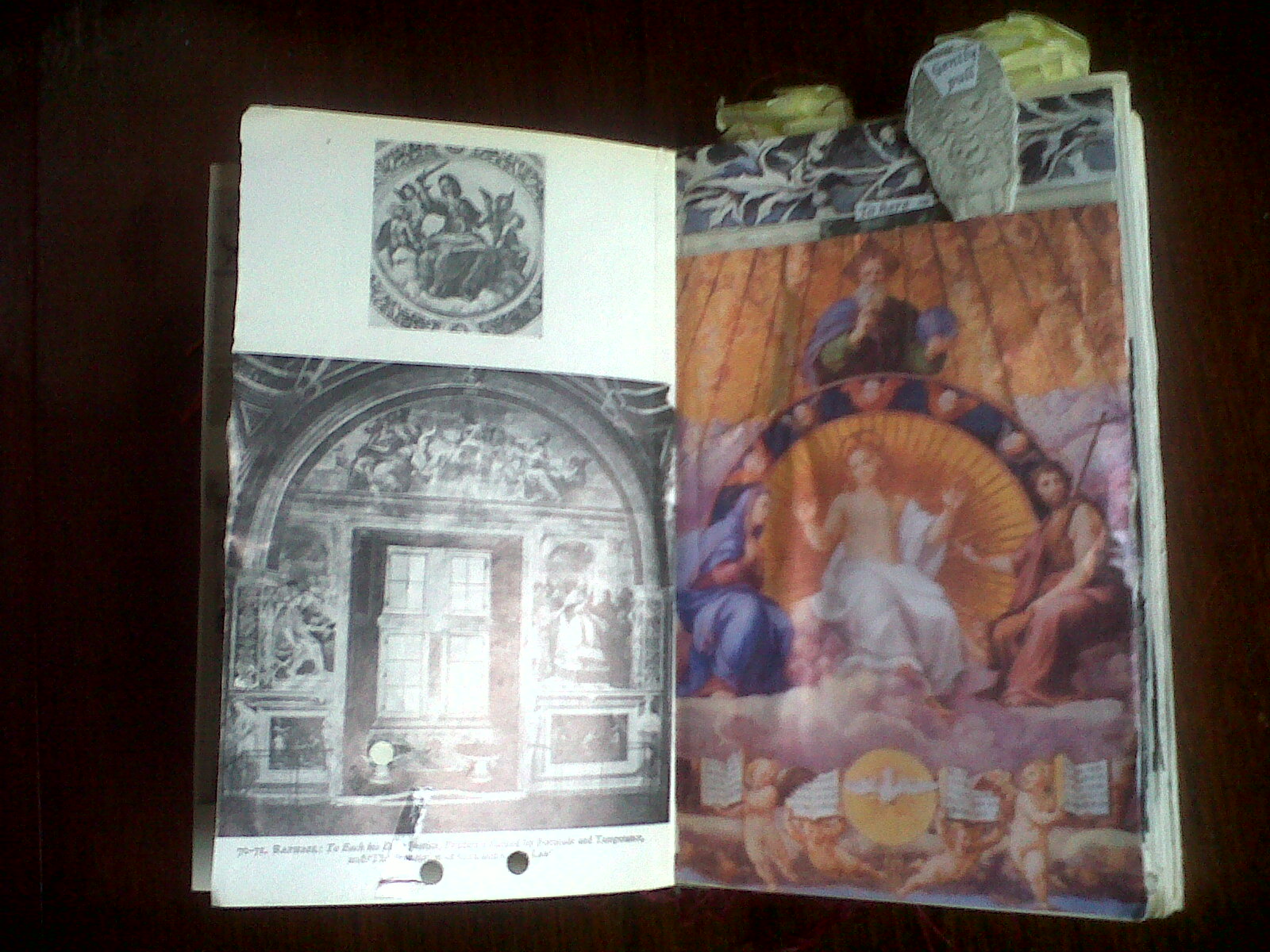


I crudely married together eclectic imagery of Raphael, John Ruskin and audio that I edited, verbalized and recorded from the Tate modern website, embedding sound within the book. My intervention attempts to lower the cultural status of the book, through pilfering the design format from pop culture. I put the gloves in an envelope, making them unusable, as I think the feel of the book is an important part of exploring. The envelope is with the book and can be opened….
I hope you have fun with my intervention, battery permitting!  :)


Friday, 27 January 2012

Intervention "Remix the text" by Katrin Lübs, November 2011

I got the book quite at the beginning. For me a book always was something valuable and I could not imagine damaging it in any way. But the destruction had already begun and that made it easier for me.

I liked the pictures at the end but the content seamed complex and difficult to read. It was a lot of small text about anything. I wanted to get an extract of information. That is how our fast world works like, to hurry and catch a quick information or impression.  


I started carefully to cut some of the pages. Thereby I felt a bit guilty to destroy somebody´s work. I did it in some parts of the book´s text. 

Now a fluent reading was no longer possible. You could get only a short idea what it is telling. That means you can think about how it could go on or you decide and everything becomes possible. You can remix the text or you also can try hard to find the ongoing part, it is up to you.


Monday, 16 January 2012

12-17th Jan, Qiuyuan Fu (Sherry)

I got the book after the New Year, it was already approaching Chinese Spring Festival, so I added some traditional elements to this book. Firstly, I put a Chinese knot on the cover page. In our culture, Chinese knot could bring happiness and blessing to people. Then I cut a flower and a butterfly on one page with a small scissors, because people in China paste the paper-cut to the windows to celebrate festivals. Finally, I made a tiny tea bag and stitched it to the last page. The tea leaves inside were from JiangSu Province, China, my hometown.

Wednesday, 11 January 2012

11.01.12 Sue Taylor


I had custody of the book over the Christmas holidays, and my first idea was to take the book on holiday with me, as I was going away for New Year.  I was going to take it on a journey, and photograph the book in different locations, as a sort of diary.  The more I thought about this the more reasons for not doing it became apparent.  Basically it seemed quite a boring idea, and also there was the danger that I would lose the book, or leave it in a field somewhere in Staffordshire.  As I looked at the book its increasing fragility was very noticeable, and I began to treat it as a ‘rare’ object, so much so that I felt I ought to be wearing white gloves to turn its pages.  So that is my intervention – to supply a pair of white gloves, which attach to the book with a cord, so that the reader can choose or not to wear them.  I found out later a couple of interesting things about white gloves – there is a website for items of clothing for masons, and white gloves are advertised for this, and white gloves are worn by magicians, which I had forgotten about.  Finally I enclose information from the British Library, which no longer recommends the use of white gloves when handling precious books! The choice is yours.

The use of white cotton gloves for handling collection items
Written by Jane Pimlott, Preservation Coordinator
General practice at the British Library
The British Library takes appropriate use and handling of collection items seriously and
we provide guidance to staff, visitors and readers on how they should handle different
types of material.
Above: Letters of different sizes can be difficult to handle
when wearing gloves
In general we do not use or provide white gloves for use with collection items. Clean dry hands, free from
creams and lotions, are preferable in the majority of circumstances. Wearing cotton gloves when handling
books, manuscripts or fragile paper items reduces manual dexterity and the sense of touch, increasing the
tendency to 'grab' at items. The cotton fibres may lift or dislodge pigments and inks from the surface of pages
and the textile can snag on page edges making them difficult to turn. All these factors increase the risk of damage to collection items.
We have reinforced the importance of having clean dry hands to readers by developing
an icon which is displayed in reading rooms and in leaflets. A series of
the British Library website also demonstrates how various types and format of collection
items are used. Included in this series is a video called ‘Using Gloves with Collection
Items’.
short videos on
When should gloves be worn?
Staff will advise readers if they need to wear gloves when handling a particular collection
item. Gloves are used when handling certain materials, for example, lead seals or when
touching the surface of a globe. In someinstitutions it is common practice to use gloves
when viewing photographs to protect the surface of the image, but in the British Library
these items are generally issued in protective sleeves or mounts making this unnecessary.
Above: The surface of a globe being examined while
wearing white gloves
Research
Research into the use of white gloves by Dr. Cathleen A. Baker and Randy Silverman is
published in the article
of International Preservation News. They discuss that ‘
gloves provide no guarantee of protection from perspiration and dirt. Further, they
increase the likelihood of physical damage occurring to paper-based collection material
by blunting the sense of touch ..…implementing an institutionally monitored, handcleaning
policy is a reasonable and effective alternative to protecting artefacts from
damage while promoting the essential humanistic experience of touch
looks at the history of wearing white gloves; a relatively recent phenomenon.
‘Misperceptions about white gloves’ in the December 2005 issuecontrary to popular opinion,’. The article also
Items on television
When collection items are seen on television, for the same reasons given above, gloves
are not usually worn. Any handling during filming is, however, always closely supervised.
In normal circumstances access to extremely rare and valuable items is highly restricted.
With some rare and valuable items, filming may be one of the few occasions when we
permit access, to allow a wider audience to see and appreciate a restricted item.

Wednesday, 28 December 2011

Intervention' From Right to Left'. Nastaran Samii. 9th -18th December 2011


I have converted the book to be opened from right side of the book instead of left side, as this is the way we open books in my culture.Consequently the reader must read from the right-page to the left-page ( first the page right and then the page left), however the text is in the left to right format.

Friday, 16 December 2011

De-construction in progress... Helen Frank

The box (nor the words written inside it) can not protect the book, rather the box has invited it's own destruction by becoming part of the book and fit for intervention.

The box was shredded and turned into paper.

The mass of the box has made one thick page which has been drawn on. This new page mimics one of the inside pages

The new page is currently seperated from the book.

Tuesday, 13 December 2011

Intervention 'Red Thread Through the Book', Silvia Champion, 1st - 8th Dec. 2011

I was interested in using the book and its words as material rather than working with the content. My original idea before I had the book was to change the shape of it by cutting into it in such a way that I can knit/knot the paper together and let a new shape grow out of the inside of the book. The interactions the book had already received prevented this.


Once I looked through the book I decided to interact directly with somebody else's interaction; communicating with it. I felt that because of all the interruptions and cuts already made, the book needed something to reconnect it. So I put a red thread through the book, connecting all the pages together. I like the connotations I found regarding the word 'thread' and how they relate to what I did with the book. For example:


the thread of an argument/ideas - connection linking them together
threads of something - various parts of it
to thread through it - to move through it
life/survival/success can hang by a thread - a delicate situation


Starting at the beginning, I put the thread through Madeleine's punched holes always using the closest  one on the opposite page to the one the thread across the book and at other times it is a short straight line depending where the next punch hole was. I stuck the thread down so when you turn the page a few more pages automatically stand up ready to flip over. This determines the way you urn the page and gives movement to a normally static object. In addition I chose a red thread that would give the paleness of the book a splash of colour.

Wednesday, 23 November 2011

Intervention 4 - Rachel Smith. 16 - 23 November 2011


In preparation for my intervention, I went to the Hallam Library in order to get a sneak preview of the book, in order to allow myself time to interact with the text. The edition I acquired was larger than the book we were using for our collaborative intervention. This led me to consider each edition in comparison to the other. I wanted to somehow connect the 2 volumes by my intervention.

I felt suprised by my way of working as I had planned to do something different to what I ended up doing, however by taking the book from the library this totally changed my reaction which was more spontaneous.
I only worked with pages in the book that were different from the copy I had taken from the library.

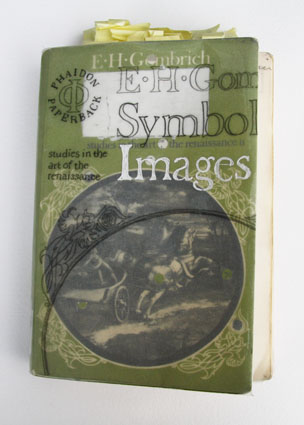
The cover is a tracing of the edition I loaned, but the size relates to the copy the group were working on. When tracing the title of the book, within the restricted size, I felt happy that there only remained the word Symbol, as Lou had removed the words symbolic and images. However to trace off the word Images would have meant putting that word back in. This lead to my decision of tracing with tippex; so technically the word has still been removed, with the same material Lou used but just so accurately it is still readable.

The drawn tracings are the illustrations put into the same places as in the version I worked with, tracing the fragment which fits within the size constraints. Each tracing is 60 seconds worth of drawing which reflects the segmented hourly structure of my work life and the restricted time I feel I have to dedicate to my own practice. The overlapping nature of the drawings gives a suggestion of what could be there and the tracings are done on both sides of the paper.

I am interested in how the added illustration pages interact with the cut pages. I also added pencil corrections to the illustration index so as to leave a clue as to how they appear in other editionsand how many illustrations are in each cluster.

Wednesday, 16 November 2011

Intervention3 Book in a Box Eva Budweg 1st November

The idea to pass a book around seemed interesting and challenging at the same time. After spending a couple of days with the book I was not sure how to feel about it. People did not just add to the book they also destroyed it in a certain way. Some parts are not readable, the pages are cut into and if one would not know the title, they could not recognize it.
There was a book, by “adding” or “doing” something to the book it changed its character. Its up to the viewer to decide if it got destroyed or was made to be a unique object.
One could argue either side.
However, I felt that it was necessary to protect the book. I know that this was an impossible task, so I decided to put the book in a box. In the box I wrote something, a section from the Bible. The Bible is just as confusing and interesting as this project, so is the particular section.
I am being aware of the fact that the book will not stay protected by the box it is in.

Thursday, 20 October 2011

Intervention 2 Madeleine Walton 12th - 19th October 2011

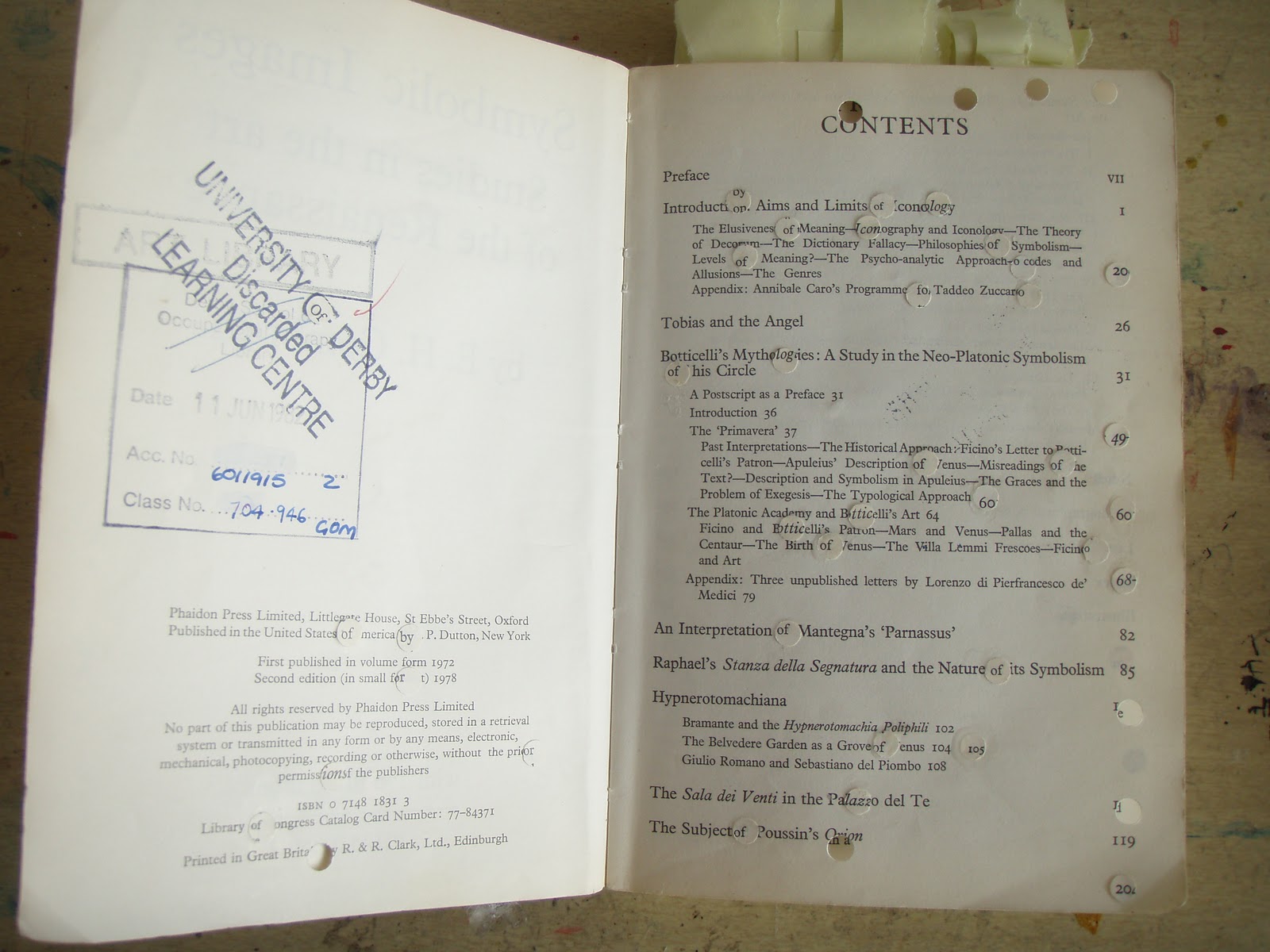
Continuing with Lou's theme of removal using the hole-punch as my tool I removed as many 'o' letters and zeros I could find. This was difficult as the hole-punch itself is constraining as it has limited reach into the page. 
After removing as many as I could remove throughout the book I had a huge pile. I then sorted through the words, numbers and letters, remembering that there are two sides to the paper so I always had a choice.I found that I had many full words: 'of','to, 'on' - some thirty of each and I went through the book using my medium glue to stick these over the matching words in the text. 
I also had partial fragments of words 'ould', 'ore', 'ough', 'ener' and found words containing these letters and glued them over.
Then I started altering words, so 'pig' became 'peck', 'sun' became 'sin', 'but' became 'hut' and this in turn completely changed the sense of the text giving sentences like "It shows a sun behind clouds" becomes "it shows a sin behind clouds" and "What needs to be added to Cicero's account" becomes "Salt needs to be added to Cicero's account". 
For the next stage I created new words. "The Age of Reason" became "The Age of Reasone", 'Louvre' became 'Loova', 'Venus' became 'Voyus'.
When I came across 'symobolic images' that Lou had underlined but overlooked I altered those words so they made no sense.
I replaced as many zeros as I could with blanks. I then altered numbers '100' became '1000' etc.
Italian text is used in the book and I substituted Italian words for English and visa versa.
When I finally got to the images in the appendix my own creativity takesover.
As I moved through the book I became less careful with letting the glue dry before turning the page as pages began to get stuck together.


The whole process was obsessive and compulsive. I was continually adding what I had subtracted and in the process leaving my trace. Every page has at least one intervention. The feel of the page is no longer smooth due to my interventions.

Thursday, 13 October 2011

Intervention 1 Lou Hazelwood 5th October 2011 - 12th October 2011


All Symbolic Images have been removed. I have removed all repetitions of these two words from the book. This statement 'All symbolic images have been removed' is bold. It also can refer to a double meaning, Does this then create some intrigue?
This process has been an obsessive task definitely not a  therapeutic one.
At points I found myself 'getting lost' in the text rather than the task; a mantra enabled me to re-focus 'symbolic images, symbolic images, symbolic images'.
Tippex, liquid for the cover, roller dry strips for the convenience and time constraints for inside, was used to remove all symbolic images. Removing the title and all its repetitions of these words throughout the book, I was surprised at how few symbolic images there were. Somehow there was an expectation that the book would be full of symbolic images and maybe it is  but these weren't evident in its repetitions of these particular words, as its bold statement (title) led me to believe.
Leaving torn markers (yellow post it notes), initially a reminder of where the symbolic images were circled in pencil, are now directing you towards the tippex-ed words. Deliberately marking the intervention, there is no room for subtlety to be present. They have created almost a 'hair-do' for the book and I have a fantasy that someone will 'topiary' them.

Of course there is power in being the first to intervene with the book but I have not regarded this as a responsibility. Therefore no thought has been given to how this may impact on others interventions, whether it will hinder, help or be of no consequence remains to be see.